Showing posts with label Calendar. Show all posts

Friday, March 18, 2016

Winter on the urban farm

Spring will be here in just a few days, so I have been contemplating winter. When I was working a desk job and dreaming of my future life on the urban farm, a couple of thoughts nagged at me: what would I do with myself all winter and would I go crazy? Sitting around my living room day after day is not my idea of a good time. I like to be busy and physically active. Now that I have a month of winter farming under my belt, I have a better picture of what next winter will look like.

So what do urban farmers do in the winter?

Winter in Wisconsin.

Planning: winter is a good time to go to your office (in my case that would be riding my fat bike through the snow to the local coffee shop) to plan for next year.

My winter office.

During the growing season and at harvest I make notes of what crops did well. This will help me decide what varieties to keep and which to replace. I also have planting maps from each year, so I can work on the next season's rotation and companion plantings. Since Two Wheels Urban Farm is in the growth stage, winter can be spent mapping out where new raised beds and other new farm additions will go and estimating supplies and budget needs.

One map iteration from my big farm notebook.

Education: there is always so much to learn! Which soil amendments are best, how can I make compost faster, and how difficult is it to raise my own chickens?  The winter provides cold weather and short days, just right for camping out at the library and reading. There are also many options for conferences and classes. This year I attended the 2016 Gardens Summit in Madison and learned about veggies, pollinators and composting while networking with local growers. There is a free online conference called the Home Grown Food Summit, and next year I'm planning to attend the 2017 MOSES (Midwest Organic and Sustainable Education Service) farming conference. I'm also currently finishing up a women's bicycle maintenance class called We Are All Mechanics-- I'm thinking Park Tool School might have my next bike repair class.

I keep re-checking out this book and should probably buy a copy for myself.

Volunteering: another important way I spend my free time is to volunteer. The winter is the perfect time of year for me to slow down and give back to the community. This year I've volunteered for three organizations that mean a lot to me: Fair Share CSA Coalition, Wisconsin Bike Federation, and the Madison Area Master Gardeners Association.

A cool sign from the Fair Share CSA open house.

I'm going to enjoy these last days of winter and start making my spring to-do list... continue indoor seed starts, fence building, prepping the beds at the community garden plot, and harvesting asparagus!

Thursday, March 3, 2016

Spring is getting real around here

Ok, I admit there are still several inches of snow on the ground, but now is the time to start thinking about planting (actually, the summer veggie growing season started about 2 weeks ago!). In my first years of gardening I made the mistake of waiting until the first warm, sunny, true spring day (probably mid-May here in Wisconsin) to decide to plant. Because I was so late getting started, I hurried to the home and garden store, or worse, a big box home improvement store, to buy whatever veggie plants they had left over (since everyone else in town suddenly also had spring fever-- it is highly contagious). The veggie plants I bought were expensive and likely not the ideal varieties for my region. For this farmer who loves a little thrill, they were probably also very boring varieties. Pick up any seed catalog and you'll see just how many fun options you have.

Fast forward a few seasons... this year I am continuing a system I started last year:
  • buy seeds early
  • for long-season crops, plant them indoors on time 
  • transplant or direct seed outdoors as early as possible
These practices allow me to not only plant unique or delicious varieties that will grow well in Wisconsin, but by planting early I can extend my growing season and maximize on my rotations (early crops, mid/late season crops, and fall crops).

Right now my system is not so fancy: shelves in a bright, southern window with a few grow lights hung to provide extra light in the morning and evenings. In the future I want to build one of these babies:


But for now, I'll work with what I have. I started some onions two weeks ago (in the back) and my current batch of microgreens (in the front):


I ran across the very handy University of Wisconsin's regional planting guide (starting on page 5) that lets me know when to start different plants indoors and outdoors. It is fantastic and I'm not sure how I grew vegetables without it. I would guess most locations have a similar resource (in the US, a good first step would be to check with your local university extension agent).

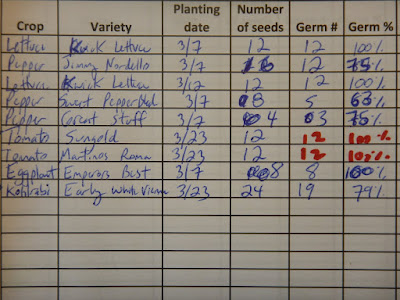
For the second year in a row I am also writing down the varieties I grow, how many seeds I start, and what the germination percentage is. This is helpful for next year to know how much to plant and whether I should plant extra seeds to get the desired number of plants. Some notes from 2015:


I'm also trying out the kindergarten thrifty urban farmer paper cup method of starting seeds. I may need to transfer them to larger pots at some point, but I know some seeds won't germinate, and some plants will germinate that I won't need, and so this is a very cheap and easy way to get things started.


So March is here and my first year of urban farming full time is off to a good start! I planted those onions on Valentine's Day, and today I started the peppers and eggplant. And although fat biking on the local pond is a ton of fun, I am ready for the snow to melt!